Research
Description:
Dr.
Kerfoot's laboratory plays a central role in the ecology
research conducted by the department of biological sciences.
This laboratory specializes on the food web structure,
ecology and paleoecology of lake communities.
Funded
research includes recently-awarded five-year National
Science Foundation (NSF) projects on Lakes Superior
(KITES) and Lake Michigan (EEGLES), a three-year NSF
project on groundwater coupling, and studies of German
and Russian lakes (including the Caspian Sea), in addition
to regionally funded work on mercury and copper in Lake
Superior basin.
Dr.
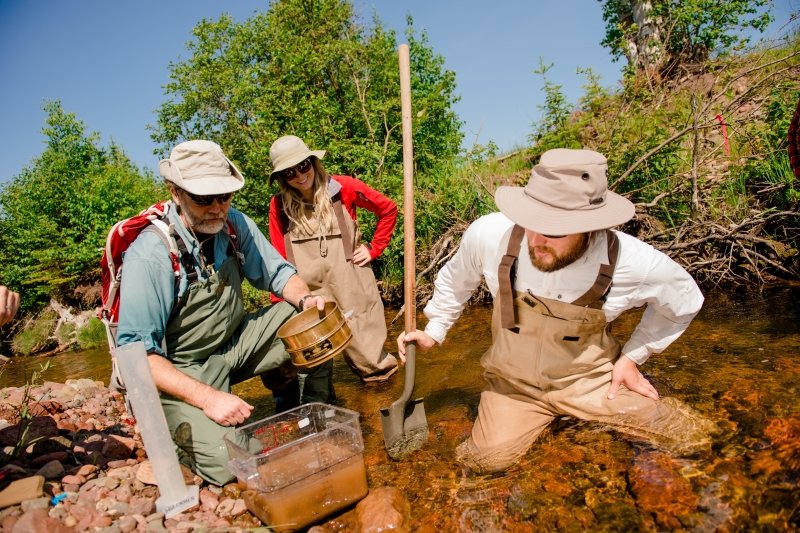
Kerfoot's portion of the KITES and EEGLES projects examines
sediment transport and how different zooplankton populations
develop in nearshore and offshore waters, the importance
of recruitment from resting eggs, and how the Keweenaw
current transports individuals and resting eggs around
the lake, creating a "coastal corridor".
Details
include genetic characterization of resting egg "seed
banks", hatching of eggs, cloning, sequencing, and testing
how ancestral individuals differ from present-day populations.
In
addition, we investigate how episodic events (large
storms) purge seed banks and maintain genetic diversity.
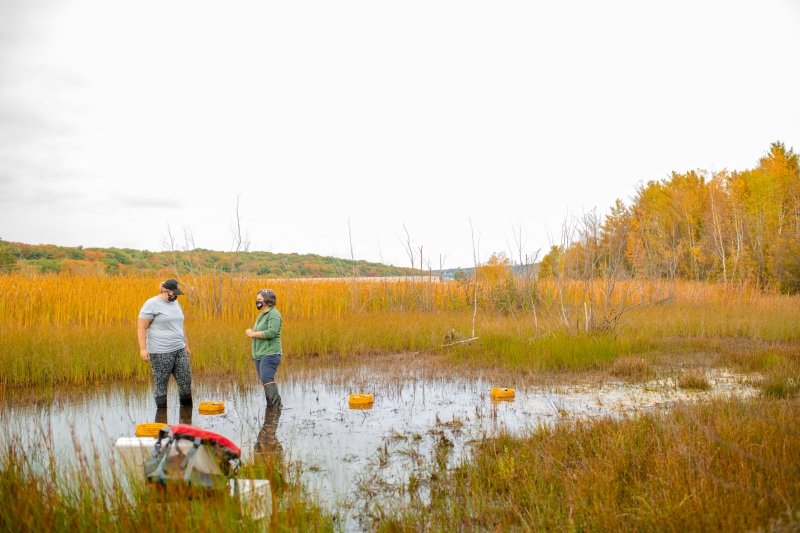
The groundwater-lake coupling study looks at how groundwater
flow naturally promotes algal communities in lakes and
maintains benthic diatom diversity.
Ocean
Color Spectrum
Recent
and Selected Publications:
- W.C Kerfoot, J.W. Budd, S.A. Green, J.B. Cotner, B.A. Biddanda, D.J.
Schwab and H.A. Vanderploeg 2007 Doughnut in the desert: late-winter
production pulse in southern Lake Michigan. Limnol. Oceanogr (In press).
- Kerfoot W. C., J.W. Budd, J.H. Churchill and C. Chen 2007 Metacommunity
perspective on zooplanktonic communities in Lake Superior. Mohi Munawar,
ed (In press).
- Kerfoot, W. C., J. Jeong, and J.A. Robbins 2007 Lake Superior mining
and the proposed mercury zero-discharge region for Lake Superior “State
Of The Lake” Mohi Munawar, ed. (In press).
- Churchill, J.H. and W.C. Kerfoot 2007 The impact of surface heat flux
and wind on thermal stratification in Portage Lake, Michigan. J. Great Lakes Res. .
33(1):143-155.
PDF File
- Kerfoot, W.C. 2006. The Baltic Eubosmina radiation: sensitivity to
invertebrate predators (induction) and observations on genetic
differences. Arch. Hydrobiol. 167(1-4): 147-168.
- Hagerthey, S.E. and W.C. Kerfoot. 2005. Spatial variation in
groundwater-related resource supply influences freshwater benthic algal
assemblage composition. J. N. Am. Benthol. Soc. 24(4): 807-819. PDF File
- Kerfoot, W. C., G. G. Mittelbach, N. G. Hairston,
Jr. and J. J. Elser. 2004. Planktonic biodiversity:
Scaling up and down. Limnology and Oceanography 49:
1225-1228.
- Kerfoot,
W.C. and L. J. Wieder. 2004. Experimental paleoecology
(resurrection ecology): Chasing Van Valen’s
red queen hypothesis. Limnology and Oceanography 49:
1300-1316. PDF
File
- Jarnagin,
S. T., W. C Kerfoot and B. K. Swan 2004. Zooplankton
life cycles: Direct documentation of pelagic births
and deaths relative to diapausing egg production.
Limnology and Oceanography 49: 1317-1332. PDF
File
- Kerfoot,
W. C. J. W. Budd, B. J. Eadie, H. A. Vanderploeg,
and M. Agy. 2004. Winter storms: Sequential sediment
traps record Daphnia ephippial production, resuspension
and sediment interactions. Limnology and Oceanography
49: 1365-1381. PDF
File
- Kerfoot,
W. C., X. Ma, C. S. Lorence. 2004. Toward resurrection
ecology: Daphnia mendotae and D. retrocurva in the
coastal region of Lake Superior, among the first successful
outside invaders? J. Great Lakes Research 30 (Supplement
1): 285-299. PDF
File
- Churchill,
J. H., W. C. Kerfoot, and M. T. Auer. 2004 Exchange
of water between the Keweenaw Waterway and Lake Superior:
Characterstics and forcing mechanisms. J. Great Lakes
Research 30 (Supplement 1): 55-63. PDF
File
- Kerfoot,W.
C., S. L. Harting, J. Jeong, J. A. Robbins and R.
Rossmann. 2004. Local, Regional, and Global Implications
of Elemental Mercury in Metal (Copper, Silver, Gold,
and Zinc) Ores: Insights from Lake Superior Sediments.
J. Great Lakes Research 30 (Supplement 1): 162-184. PDF
File
- Barnhisel,
D.R. and W. C. Kerfoot. 2004. Fitting into food webs:
Behavioral and functional response of young lake trout
(Salvelinus namaycush) to an introduced prey, the
spiny cladoceran (Bythotrephes cederstroemi). J. Great
Lakes Research 30 (Supplements 1) 300-314. PDF
File
- Compton,
J. A. and W. C. Kerfoot. 2004. Colonizing inland lakes:
Consequences of YOY fish ingesting the spiny cladoceran
(Bythotrephes cederstroemi). J. Great Lakes Research.
30 (Supplement 1): 315-326. PDF
File
- Kerfoot,
W. C., A. Robbins, and L. J. Weider. 1999. A new approach
to historical reconstruction: combining descriptive
and experimental paleolimnology. Limnology and Oceanography
44(5): 1232-1247. PDF
File
- Hagerthey,
S.E. and W. C. Kerfoot. 1998. Groundwater flow influences
the biomass and nutrient ratios of epibenthic algae
in a north temperate seepage lake. Limnology and Oceanography
43 (6): 1227-1242.
- Kerfoot,
W. C., R. M. Newman, and Z. Hanscom III. 1998. Snail
reaction to watercress leaf tissues: reinterpretation
of a mutualistic ``alarm'' hypothesis. J. Freshwater
Biology 40:201-213.
- Budd,
J.W., W.C. Kerfoot and A.L. Maclean. 1998. Documenting
complex surface temperature patterns from Advanced
Very High Resolution Radiometer (AVHRR) imagery of
Saginaw Bay, Lake Huron. J. Great Lakes Research 24(2):
582-594.
- Newman,
R. M., W. C. Kerfoot and Z. Hanscom III. 1996. Watercress
alleochemical defends high nitrogen foliage against
consumption: Effects on freshwater invertebrate herbivores.
Ecology. 77(8): 2312-2323.
- Kerfoot,
W. C. 1995. Bosmina remains in Lake Washington sediments:
Qualitative heterogeneity of bay environments and
quantitative correspondence to production. Limnology
and Oceanography 40(2): 211-225.
- Kerfoot,
W. C., G. Lauster, and J.A. Robbins. 1994. Paleoecological
study of copper mining around Lake Superior: Artificial
varves from Portage Lake provide a high resolution
record. Limnology and Oceanography 39: 649-669.
- Kerfoot,
W. C., and A. Sih (editors). l987. Predation: Direct
and Indirect Impacts on Aquatic Communities. University
Press of New England, Hanover. N.H. 386 pp.
- Kerfoot,
W. C. (editor). l980. The Evolution and Ecology of
Zooplankton Communities. University Press of New England,
Hanover. N.H. 793 pp.
Earlier Selected Publications
- Kerfoot, W. C. and D. L. DeAngelis. 1989. Scale-dependent dynamics: zooplankton and the stability of freshwater food webs. Trends in Ecology and Evolution 4: 167-171.
- Kerfoot, W. C., C. Levitan, and W. R. DeMott. 1988. Daphnia-phytoplankton interactions: Density-dependent shifts in resource quality. Ecology 69: 1806-1825.
- Kerfoot, W. C. 1987. Translocation experiments: copepod predation on Bosmina. Ecology 68: 596-610.
- Kerfoot, W. C., W. R. DeMott, and C. Levitan. 1985. Nonlinearities in competitive interactions: component variables or system response? Ecology 66: 959-965.
- DeMott, W. R., and W. C. Kerfoot. 1982. Competition among cladocerans: coexistence of Bosmina and Daphnia. Ecology 63: 1949-1966.
- Kerfoot, W. C. 1982. A question of taste: crypsis and warning coloration in freshwater zooplankton communities. Ecology 63: 538-554.
- Manning, J., W. C. Kerfoot, and E. M. Berger. 1978. Phenotypes and genotypes in cladoceran populations. Evolution 32: 365-374 PDF File
- Kerfoot, W. C., R. Pastorok. 1978. Survival versus competition: Evolutionary compromises and diversity in the zooplankton. Verh. Internat. Verein. Limnol. 20: 362-374. PDF File
- Kerfoot, W. C. 1977. Implications of copepod predation. Limnol. Oceanogr. 22: 316-325. PDF File
- Kerfoot, W. C. 1977. Competition in cladoceran communities: The cost of evolving defenses against copepod predation. Ecology 58: 303-313. PDF File
- Kerfoot, W. C. 1975. The divergence of adjacent populations. Ecology 56: 1298-1313.
- Kerfoot, W. C. 1974. Net accumulation rates and the history of cladoceran communities. Ecology 55: 51-61. PDF File
|